Pull, Don't Reach: A Joiner's Honest Take on Drawers in Fitted Furniture
Ask most people what they want from a fitted cupboard and you will get the same answer: shelves. Maybe a rail. Perhaps a drawer at the bottom if they are feeling fancy. It is understandable. Doors and shelves are the default because they are familiar, cheaper, and they look tidy in a photograph. But after a few years of real life — school shoes, saucepans, spare bedding, the box of Christmas decorations that never quite found a home — the bottom shelf becomes a place where things go to be forgotten. That is usually when the drawer conversation starts.
I am not anti-door. A well-made cupboard is a lovely thing, and there are jobs only a door can do. But if you are planning a fitted run this year, it is worth asking a simple question before the design is fixed: will I be reaching into this, or pulling it towards me?
Where a drawer does the heavy lifting
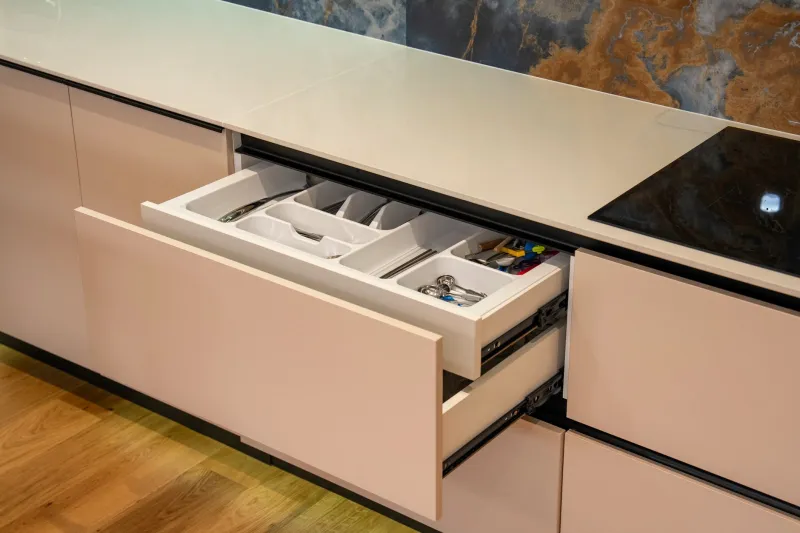
Drawers are at their best when the contents are heavy, small, daily or deep. A pan drawer under a hob is the obvious example. You pull it out and the whole shelf comes to you, rather than you kneeling on the floor to excavate a roasting tin from the back. The same logic applies in a hallway bench: one deep drawer for gloves, hats, dog leads and the odd school letter is far more useful than a low cupboard where everything migrates to the rear.
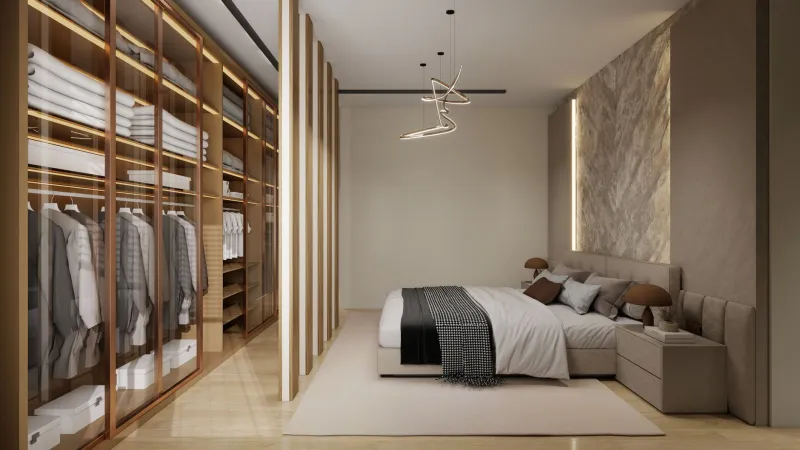
In a wardrobe, a bank of drawers at the base earns its keep for folded clothes, gym kit and the things that never hang well. Under the stairs, low drawers can turn a dead corner into useful storage for shoes, tools or board games without asking anyone to crawl inside. In an alcove, a couple of wide drawers below and adjustable shelves above is a sensible split for a living room or home office.
The reason is simple: a drawer brings the back of the cupboard into the light. A shelf asks you to move one thing to reach another. A drawer asks you to pull a handle.
Where a door still earns its place
Not every cupboard should become a chest of drawers. Tall larder units, broom cupboards, airing cupboards and wardrobes with long hanging all suit doors. So do the places where you store bulky, occasional or awkward things: suitcases, ironing boards, vacuum cleaners, wrapping paper, large platters, the step ladder. If you only touch something twice a year, a door and a shelf is honest. If it is long and unwieldy, a drawer is a poor fit.
There is also the question of clearance. Drawers need space in front of them to open, and you need space to stand while you pull. In a narrow galley kitchen or a tight alcove, a door can sometimes be the more practical choice because it does not demand the same pull-out zone. A pull-out shelf behind a door can be a useful compromise, but it is not the same as a proper drawer on good runners.
The bit nobody warns you about
Drawers cost more. There is no way around it. You are paying for boxes, runners, alignment and the time it takes to get everything running sweetly. A cheap drawer is worse than a shelf because it will fail, stick or sag, and then you will resent the whole run. If the budget is tight, spend it on the drawers you will use every day and keep the rest simple.
A few details matter more than the number of drawers. Full-extension runners let you see and reach the whole box. A sensible load rating matters for pans and tins. Solid drawer boxes and proper adjustment make the difference between a drawer that glides for fifteen years and one that starts catching after eighteen months. And handles should suit the room, not just the catalogue.
Mixing drawers and doors without turning the place into an office
The trick is to design in zones rather than treating the whole wall the same way. In a wardrobe, put drawers in the lower third and hanging above. In a kitchen, use pan drawers at base level and doors on the tall units. In an alcove, keep the lower section as drawers and the upper section as shelves. In a boot room, one deep bench drawer can do more work than three narrow cupboards.
Avoid the filing-cabinet look. A wall of twelve shallow drawers is rarely the answer in a home. Fewer, deeper drawers usually store more and feel calmer. If you need small-item organisation, an internal drawer behind a door can be a neat solution without breaking up the front elevation. Keep the proportions quiet and the handles consistent, and the room will still look like a room rather than a piece of office furniture.
A simple test before you sign off
Ask yourself: would I have to move one thing to reach another? If yes, a drawer is probably better. Is it heavy? Drawer. Do I use it daily? Drawer. Is it long, bulky or occasional? Door. Is the space so tight that pulling out would be a nuisance? Door, or a carefully planned pull-out.
It also helps to pull a real drawer before you commit. Not a picture of one, and not a sample board. A properly made drawer on decent runners tells you more in five seconds than a page of specifications. If your joiner has a workshop, ask to see one. A good one will be happy to show you.
Fitted furniture should make the everyday slightly easier. In plenty of UK homes, that means fewer doors and a few more drawers in exactly the right places. Not everywhere. Just where you would otherwise spend your life reaching.