The Cheapest Fitted Furniture Quote Rarely Stays Cheap — A Joiner's Honest Warning
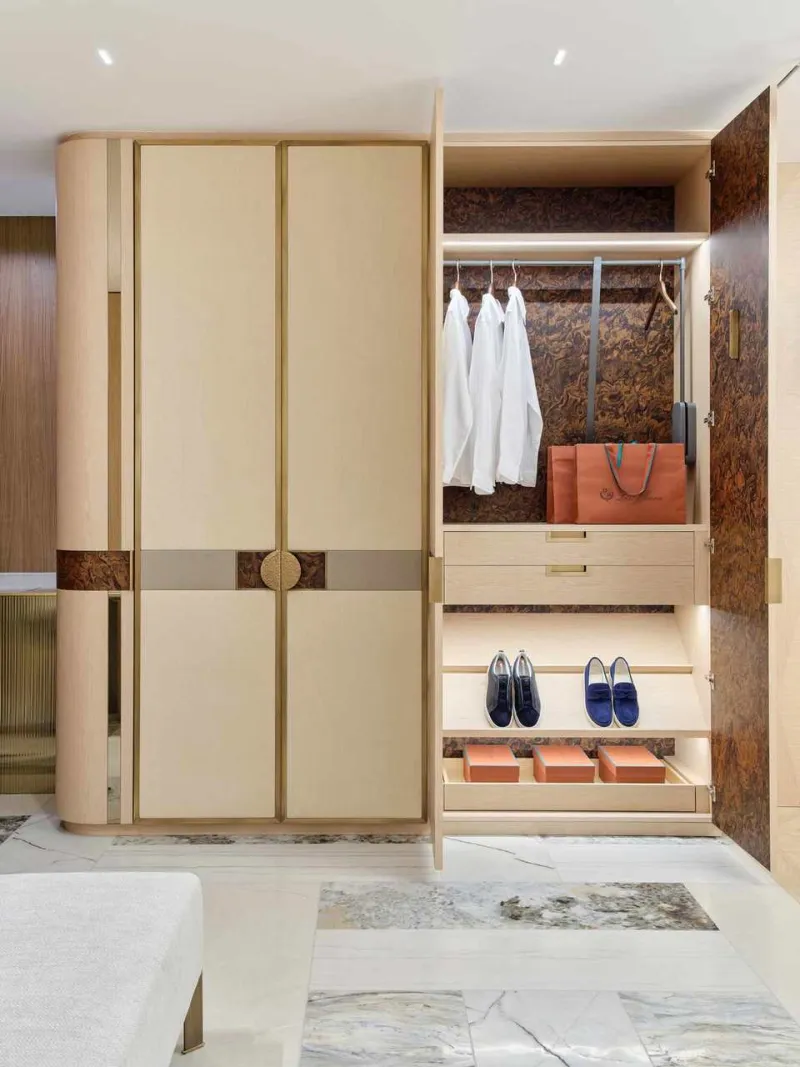
Photo: Faura Ltd, CC BY-SA 4.0, via Wikimedia Commons
We get asked to look at a lot of fitted furniture that somebody else put in. Bedrooms mainly, alcove units, the odd under-stairs job. Usually the call comes three or four years after installation, and the complaint is almost always the same: the doors have dropped, the shelves have bowed, the drawers stick, or the whole thing has pulled away from the wall.
Almost none of that was visible on the original quote. That's the thing about cheap fitted furniture — the price is cheap, but the cost arrives later.
This isn't a pitch against the big retailers. Plenty of people buy mass-market wardrobes and are perfectly happy. But there's a real gap between what a low quote appears to buy and what it actually delivers, and UK homeowners deserve to know where it is before they hand over a deposit.
What "cheap" is actually made of
Open the specification on a budget fitted bedroom quote and you'll usually find 15mm particleboard carcasses with a paper foil finish. It looks fine in a showroom. In a spare room that gets cold in winter and warm in summer, foil lifts at the edges and particleboard swells the moment moisture gets anywhere near a cut edge.
Compare that with 18mm moisture-resistant MDF, properly primed and painted, or birch plywood where the grain is on show. The difference in material cost is real — often 30–50% on the carcass alone — and it's the single biggest reason one quote comes in lower than another.
Then there's the construction. Dowel-and-cam fittings are quick to assemble and fine for a flat-pack bookcase. They are less fine for a wardrobe carrying a full rail of coats. A properly built carcass is glued, screwed and braced, with a solid back panel that stops the whole unit racking. Drawer boxes are another tell: stapled and glued MDF versus dovetailed or properly jointed boxes on runners rated for the load.
The installation blind spot
Here's the part that rarely appears on any quote, cheap or otherwise: how the thing actually gets fitted into your house.
UK houses are not square. Victorian terraces have wavy plaster and walls that lean. 1930s semis have chimney breasts that were never plumb. New-builds settle and move in the first few years. Any fitted furniture has to be scribed to those imperfections — cut to follow the wall rather than butted against it and hidden with a bead of caulk.
Scribing takes time, and time is what a low quote has already squeezed out. Fitters working to a per-unit rate have an incentive to be quick. You end up with a gap down one side filled with sealant, doors that don't line up because the carcass isn't true, and a run of wardrobes that looks fine from the doorway and slightly wrong from anywhere else.
Ask, specifically, who will install it. The same firm, or a subcontractor you'll never speak to again?
The storage efficiency illusion
A standard carcass is 500mm or 600mm wide. A chimney alcove in a Victorian terrace is frequently 1,150mm. Do the arithmetic: two standard units leave a dead 150mm gap, and the awkward return around the chimney breast gets boxed in.
Bespoke work is designed around the actual dimensions, which is why it usually delivers noticeably more usable storage in the same footprint. The same applies to depth — standard wardrobe depth in a shallow alcove means either a unit that sticks out into the room or one with a useless void behind it.
If two quotes are for wildly different numbers of units, or one is quoting standard widths and the other is measuring, you are not comparing like with like.
A practical checklist for comparing quotes
- Get the specification in writing. Carcass material and thickness, back panel, shelf thickness and maximum unsupported span, hardware brand, finish. If a supplier won't put it in writing, that tells you something.
- Ask who installs it — and whether the fitter is employed, contracted, or a franchisee.
- Ask how they handle an out-of-square wall. The right answer involves scribing or a filler panel. The wrong answer is "sealant".
- Inspect a drawer box. Is it jointed or stapled? What load are the runners rated to?
- Ask about shelf spans. An 18mm MDF shelf over 900mm will sag under books unless it's supported or upgraded to 25mm.
- Raise ventilation. Alcoves with disused chimney breasts, cupboards with meters, anywhere damp clothing lives — these need air, not a sealed box.
- Get the warranty in writing, including who honours it and what it covers. Ten years on paper means nothing if the company has changed hands.
- Visit a recent installation, not the showroom. Ask to see a job from two years ago if you can.
- Compare totals, not headlines. A quote for three units against a quote for five is not a saving.
What craftsmanship actually pays for
It pays for design time — somebody sitting down with a tape and a level before a single panel is cut. It pays for scribing, for hand-painted or spray-finished surfaces, for hinges and runners that can be replaced with standard fittings in fifteen years rather than being discontinued next season.
It also pays for repairability. A well-built unit can have a door re-hung, a shelf adjusted, a drawer runner swapped. A foil-wrapped particleboard carcass that has swelled at the base is a skip job, and the wardrobe above it goes with it.
The resale conversation
Nobody buys a house because of the wardrobes. But buyers do open them. They pull drawers, they look at how the doors close, they notice whether the alcove unit looks like furniture or like something assembled in place.
Fitted furniture shows up in every photograph an estate agent takes of a bedroom. A wobbly run of units reads, fairly or not, as "work needed" — and that negotiation starts at a higher number than the difference between the two quotes ever was.
The short version
The cheapest quote is rarely the cheapest outcome. Spend an hour with the specifications before you sign, ask the awkward questions, and if a price looks too good for the amount of material and labour involved, it usually is. Bespoke isn't cheap, but it's the only version of this that you won't be paying for twice.