What Your Joiner Means by 18mm — and Why It Isn't the Whole Story
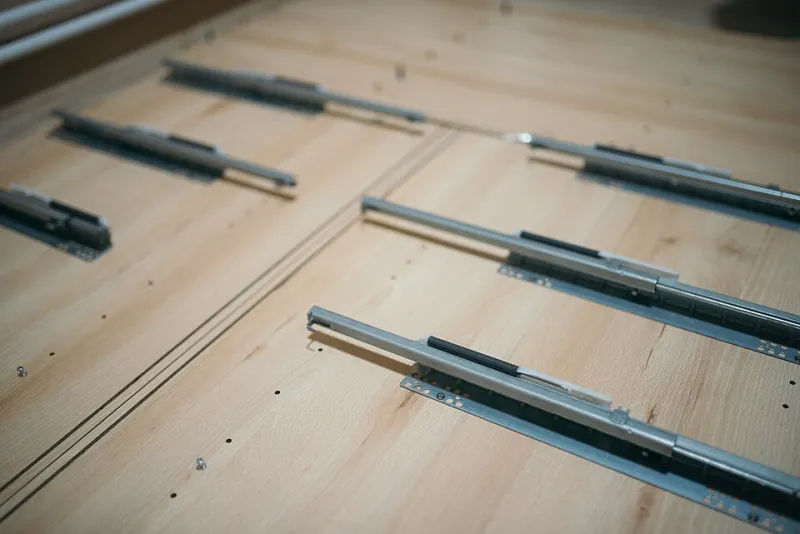
Photo: Shixart1985, CC BY 2.0, via Wikimedia Commons
You'll see it on almost every fitted furniture quote: '18mm carcass'. Sometimes it's printed in bold, as if the number alone settles the matter. It doesn't. Board thickness is a useful specification, but it's only one part of how a piece of joinery behaves. A wardrobe with 18mm sides and a flimsy back is not automatically better than one built with 15mm panels and proper bracing. A 25mm shelf can still sag if it's asked to span too far without support. The number matters, but context matters more.
The number on the quote is a starting point, not a badge
In bespoke joinery, thickness is chosen per component. A typical fitted wardrobe might use 18mm for the carcass, 18mm for shelves, a thinner back panel, and 22mm doors. A drawer box might use 12mm or 15mm sides with a thinner bottom. So when a quote says '18mm', it's worth asking which parts are 18mm — and which aren't. The question isn't suspicious; it's the sort of thing a good joiner should be able to answer without reaching for the calculator.
Thickness affects four main things: stiffness, weight, fixing strength and cost. It also affects how much internal space you keep, especially in tight UK alcoves and box rooms where every millimetre is doing a job.
Where thickness earns its keep: shelves and spans
The most common place thickness really shows is shelving. A shelf is a beam, even if it doesn't look like one. The wider the unsupported span and the heavier the load, the more stiffness it needs. A 15mm shelf over a short span with light bedding might be perfectly sensible. The same shelf over a 900mm alcove loaded with books, vinyl or kitchen kit is asking for trouble. An 18mm board will usually be a better default there, and a 25mm board may be right for long, heavy-duty spans — but only if the supports and fixings suit it too.
Shelf depth, material, edge banding and whether the shelf is fixed or adjustable all play a part. A fixed shelf screwed and glued into a carcass behaves differently from an adjustable shelf resting on pins. If you're planning a run of alcove shelving in a Victorian terrace, ask what the unsupported span will be and what the joiner expects it to carry. 'It'll be fine' is not a specification.
Carcass rigidity is about joints and backs as much as board size
An 18mm carcass is a sensible default for fitted wardrobes and much built-in furniture. It takes fixings well, holds its shape and gives hinges and runners something solid to work with. But a thick board joined badly is still a bad box. The back panel, the method of jointing, the squareness of the build and the way it's fixed to the wall all affect rigidity. A thin back panel that's simply pinned on can let a carcass rack; a properly housed or screwed back can add real stiffness.
This is why it's unwise to treat 18mm as a quality guarantee. Two quotes can both say 18mm and produce very different furniture. One may use moisture-resistant boards in a utility room and properly braced backs; the other may not.
Doors and drawer fronts: thickness changes feel and clearance
Door thickness is a separate conversation from carcass thickness. An 18mm door is common; 22mm gives a more substantial feel and can help with larger doors, but it also adds weight. That weight has to be carried by the hinges and the carcass. A 25mm door on a tall wardrobe might feel lovely to open, but it needs hinges rated for it and a carcass that won't flex. In a small room, thicker doors can also reduce clearance around handles and adjacent furniture.
Drawer boxes are often thinner than people expect. A 12mm or 15mm drawer side can be perfectly strong when the box is designed properly and runs on good runners. A thicker drawer side isn't automatically better; it can simply reduce the internal width.
Where 15mm is quietly fine
There are places where 15mm is not a compromise. Cabinet backs, drawer bottoms, service panels and short internal shelves with light loads can all be fine in thinner material. In a low-load utility cupboard or a small boot-room bench, the difference between 15mm and 18mm may never show itself. The trick is knowing which parts are doing structural work and which are closing a gap or providing a surface.
Where 25mm can be money poorly spent
Thicker boards are not free. They cost more, weigh more and can put extra load on hinges, runners and wall fixings. In a narrow alcove, 25mm panels on both sides can eat 20mm of usable width before you've even thought about doors. In a small wardrobe, that might be the difference between hanging a coat comfortably and not. Over-specifying the carcass while under-specifying the shelf supports is a classic way to spend money in the wrong place.
Material matters as much as millimetres
An 18mm sheet of MDF is not the same as an 18mm sheet of plywood or chipboard. They differ in weight, screw-holding, moisture resistance and how they move. In kitchens, utility rooms and bathrooms, moisture-resistant boards are often more important than an extra few millimetres. In period homes, movement and fixing method can matter more than raw thickness. A joiner should be choosing the board for the job, not just quoting a number because it sounds reassuring.
Questions worth asking before you compare quotes
- Which panels are 18mm, and which are thinner?
- What is the longest unsupported shelf span, and what load is it designed for?
- Are shelves fixed or adjustable, and how are they supported?
- What is the back panel made from, and how is it fixed?
- What thickness are the doors and drawer fronts, and are the hinges and runners rated for them?
- Is moisture-resistant board being used near sinks, appliances or external walls?
- Will thicker boards reduce the usable internal space in a way that matters?
None of these questions are awkward. They're the normal language of specifying fitted furniture properly. The honest answer is that 18mm is a good, sensible default for much bespoke joinery in UK homes — but it is not a magic number. Thickness should follow function. Ask what each board is doing, and you'll get furniture that fits the room rather than a line on a quote that sounds impressive and means very little on its own.