A Torch, a Cloth and Twenty Minutes: The Winter Check for Fitted Joinery
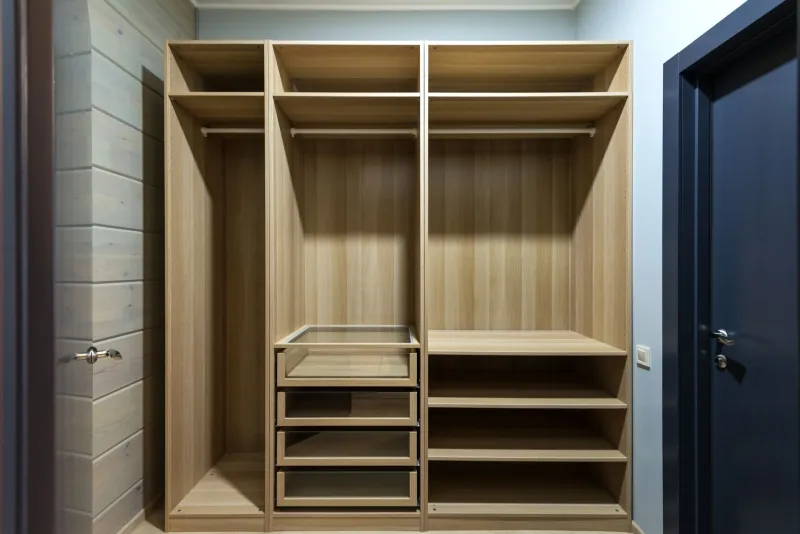
By early November 2026, most UK homes have made the same quiet switch. The windows are shut more often, the heating has come on, and the air inside has started to dry out. For fitted wardrobes, alcove cabinets, built-in desks and kitchen joinery, that shift is worth paying attention to. Not because anything is necessarily wrong — but because timber responds to the house it lives in, and November is a good moment to notice what it is saying.
This is not a fault hunt, and it is certainly not a reason to start pricing up replacements. Think of it as a twenty-minute walk-round with a torch, a soft cloth and a pencil. You are looking for changes, not perfection.
Start where the house works hardest
Begin in the rooms that get the most use: bedrooms, the kitchen, the utility, maybe the hallway cupboard that swallows coats and boots. Open every fitted door and drawer. Not just a nudge — run drawers through their full travel and close doors properly. Listen for a change in sound. A drawer that has started to rumble, a wardrobe door that needs a firmer push, or a cupboard that no longer sits flush is giving you useful information.
Look along the top and bottom edges of doors. Check the gap between a door and its frame. Check the shadow line where a cabinet meets a wall. In a well-fitted piece, these lines should be consistent. If one has tightened up since the summer, note it. If a hairline gap has appeared at a mitre or along a painted joint, note that too. You are building a small record, not diagnosing on the spot.
What timber is doing when the heating comes on
Timber is hygroscopic. It takes in and gives out moisture as the air around it changes. In a typical UK autumn, indoor air can be fairly damp. Once the heating is running regularly, relative humidity drops and timber loses a little moisture. Doors can shrink very slightly, drawers can loosen, and fine gaps can open at joints. None of that is unusual.
The opposite happens too. A bathroom cabinet, a utility cupboard or a wardrobe on a cold external wall may pick up moisture from showers, cooking or poor ventilation. A door can swell just enough to bind. A drawer runner can feel tight. A painted edge can rub. Again, this is timber doing what timber does. The question is whether the movement is small, seasonal and stable — or whether it is getting worse.
The drawer and door audit
For drawers, pull each one out slowly and push it back. A little resistance in humid weather is common. A hard stop, a scrape, or a drawer that will not close without a shove is worth investigating. Look at the runners if you can see them. Check for loose screws, sawdust, or anything that has dropped into the track.
For doors, open and close them a few times. Watch the hinge side and the latch side. A hinge that has started to squeak is not an emergency, but a hinge screw that has begun to stand proud or spin freely is a sign to stop and get it looked at. Check the top and bottom clearance. Doors that rub at the bottom in winter often tell you more about humidity and floor movement than about the door itself.
Soft-close mechanisms deserve a mention. They are brilliant when they work and annoying when they don't. If a soft-close drawer has stopped cushioning, it may simply need adjustment. If it has become stiff or noisy, leave it alone rather than forcing it.
Look low, high and behind
Get the torch out and look at the places you don't normally see. Under the sink. Behind the kickboards if they are removable. Along the back edge of a wardrobe. At the top of tall cabinets. Look for dark patches, flaking paint, white bloom or a musty smell. Those are not timber movement; they are moisture signals, and they deserve attention.
Also check the outside faces of fitted furniture that sit against external walls. A cold spot behind a wardrobe can attract condensation. That does not mean the joinery is faulty, but it may mean the room needs better ventilation or the furniture needs a little more breathing space. Fitted does not mean sealed forever.
Draughts, gaps and the temptation to fill everything
A small draught around a built-in cabinet is not automatically a defect. Old houses move, floors slope, and skirting boards are rarely perfectly straight. But a new draught where there was none before, or a gap that lets cold air run along a wall, is worth noting. Do not reach for the sealant gun straight away. Some gaps need to stay open for air movement; others need a proper joinery fix rather than a smear of filler.
What needs a joiner's attention
Most November changes are minor. The ones that deserve a call are straightforward: a door that has warped enough to stop closing, a hinge that has pulled out of the carcass, a drawer runner that has failed, water staining, mould growth, splitting timber, or a joint that has opened far more than a hairline. If a fitted wardrobe door has started to catch the ceiling or floor, stop using it and have it adjusted.
A decent joiner would rather adjust a hinge or ease a drawer now than rebuild a carcass later. That is not a sales pitch; it is just the cheaper and calmer option.
Leave the small stuff alone
Hairline cracks in painted joints, a faint creak when you step near a cabinet, a drawer that feels slightly tighter in damp weather — these are often part of owning timber furniture in a real house. Over-tightening screws, forcing drawers or filling every seasonal gap can cause more harm than good. Make a note, take a photo, and see how it behaves over the next few weeks.
The point of the walk-round
Twenty minutes in November will not solve every joinery issue, but it gives you a baseline. You will know what is normal for your home, what has changed, and what is worth a second look. In a well-built fitted piece, most of what you find will be reassuringly boring. That is exactly the point.
At MTW Joinery, we would rather homeowners understood their woodwork than worried about it. A torch, a cloth and a little attention go a long way.